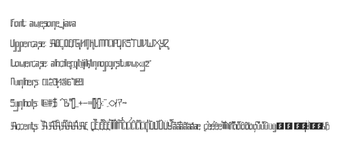
Javanese-inspired decorative TrueType font for headline use
Simulates Javanese script forms while keeping Latin characters readable, suited to headlines, logos, and themed graphics (bold, stylized strokes with decorative swirls). Created by Adien Gunarta under the professional name Awesome Java, this display typeface ships as a standard TrueType font. It offers a complete alphanumeric set, handcrafted glyphs from FontStruct, and a small file size (about 132 KB). Designers seeking a culturally themed display face for branding and social graphics will find it purpose-built for decorative accents.
What the font changes about your typography
It applies a Javanese-style decorative voice to Latin text. The font’s simulation aesthetic reproduces flowing, script-like strokes and deco swirls, so headlines and logos adopt an Indonesian-inspired look without replacing native script. The typeface includes uppercase, lowercase, digits, and standard punctuation, meaning you can set titles and short brand marks entirely in this face.
How much typographic control you get
It gives straightforward display control rather than advanced typographic features. Distributed as a single TrueType file, the font supports basic weight and size scaling in any application that reads TTF. It does not advertise multiple weights, variable axes, or extended Unicode blocks; use-size, letterspacing, and stylistic spacing from your design software to refine headings.
Installation, compatibility, and workflow impact
Installation and cross‑app use are simple and low overhead. The .ttf file installs on Windows with a right-click Install action and is compatible with common desktop apps such as office suites and Creative Cloud. The file size is approximately 132 KB, so it adds negligible storage and runs as a regular system font with no persistent background process.
Who should use this font and one caveat
Awesome Java suits graphic designers and creators who need a decorative Latin face with a Javanese visual motif, particularly for headlines and brand marks. Licensing restricts commercial use without the designer’s specified permission or donation, so confirm the license text before using it in revenue-generating materials. For noncommercial or concept work, the font supplies a distinctive cultural aesthetic with minimal technical friction.